
enquiry only
Nothing here is bought with a card.
reply from a teacher
A real person reads every enquiry.
format first
In person or live online across the UK.
fees later
Discussed once we know the shape of it.
no obligation
Deciding not to proceed is fine.
How the Enquiry Process Works, Step by Step
Send an enquiry, a teacher reads it, and we reply with guidance and the slots that are open. This page walks through what happens between the form and your first lesson.
Why no price list
A lesson fee depends on the format, the level you are starting from, and how often you want to play, so a number printed on a page would mislead most people who read it.
That is the whole reason the site runs on an enquiry form rather than a checkout. You tell us what you want to play and when you can play, and we come back with guidance, a realistic format, and what is open in the diary. Nothing is charged for that first conversation, and there is no obligation attached to it.
Below is the same process a teacher walks through with every new enquiry, written out in order so you know what to expect at each stage.
The four steps
From the form to the first lesson, in four steps
Read top to bottom.
-
1
The enquiry form
The form asks for your level, the styles you are interested in, and roughly when you can play. It is short on purpose. There is no need to write an essay, and no need to know the difference between mixolydian and dorian before you get in touch. If you are a complete beginner, saying so is useful information rather than an embarrassment. The more honest you are about your available practice time, the more useful the reply will be.
One form, one page. Everything you leave out can be worked out in the first lesson.
What we ask: level, styles, and the days and times that realistically work for you.
-
2
We read it and reply
Your enquiry goes to the studio, not into a queue. A teacher reads it and responds with genuine guidance, which sometimes means saying that a different format or a different teacher would suit you better. Replies go out during the working week, Monday to Friday 9:00 AM to 6:00 PM, so a weekend enquiry is answered at the start of the week.
If your goals are unusual, such as preparing for a specific audition or exam, mention it and the answer will be more specific. There is no obligation attached to any of this, and you can ask questions before deciding anything.
Written by a teacher, not an auto-reply. Expect plain language and a straight answer.
-
3
Format and availability
We match your goals to a format, in person at the Denmark Street studio in London or in Westminster, or live online anywhere in the UK, and then check what slots are open. Evenings and weekends go first, so flexibility on the day helps. Fortnightly lessons suit people whose weeks are unpredictable, and in practice they work better than holding a weekly slot you keep having to move.
You will get an honest picture of what is available, including the shape of the term, before you decide anything.
In person in London and Westminster, or live online. Fortnightly options for irregular weeks.
-
4
Fees and confirmation
Fees are discussed directly once we know the format, the length, and the frequency you want. They are not published on the site, because a number without that context would be wrong for most people reading it. Once the details are agreed and you are happy with them, the first lesson is booked into the diary.
If you decide not to proceed, that is a perfectly fine outcome and you will not be chased. Nothing is charged for the initial conversation.
Agreed between us, in writing, before anything is booked. No card details are taken on this site at any point.
Two lanes
In person, or live online from wherever you are
Both lanes run the same lesson plan and the same diagnostic first session. What changes is the room and the travel time, so pick the lane you can genuinely keep up with week after week.
In person
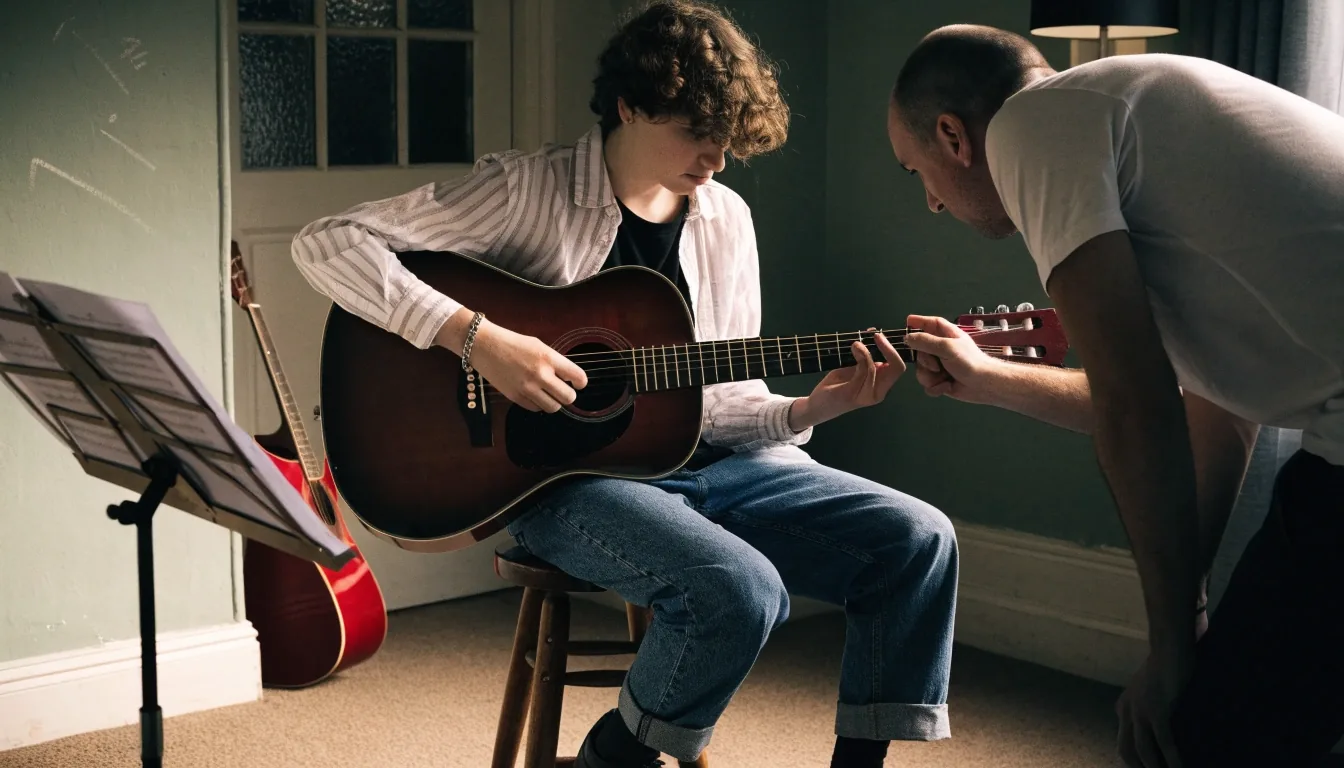
Lessons at the studio, where a teacher can hear the instrument without any delay in the signal and can reach over to fix a hand position the moment it needs fixing. Useful for posture, picking technique, and anything where you want someone watching your hands at close range.
Best suited to learners in London and Westminster, or anyone happy to travel in for a session they keep.
Live online
A live video lesson wherever you are in the UK, with the same teacher and the same term plan. You need a guitar, a reasonably quiet room, and a connection steady enough to carry a conversation. We send what to prepare beforehand so the hour is not spent setting up.
Best suited to learners outside London, or anyone whose commute makes a studio slot unrealistic.
Switching
You are not locked into one lane. Plenty of learners do a term in the studio and move online over the winter, or keep a fortnightly studio slot and add an online session when a piece needs more attention. Say which lane you are leaning towards in the enquiry and we will tell you honestly whether the diary supports it.
For a fuller breakdown of styles, levels, and what each format covers, the lessons page sets it out.
See lesson formats
Before lesson one
What to prepare before lesson one
Nothing on this list is a test. It is simply what makes the first hour land sooner.
-
A guitar, if you own one
Bring it. If it has not been played in years, bring it anyway, string condition is one of the first things we look at.
-
One or two songs you want to play
They do not have to be guitar songs. A favourite track shapes the plan immediately, because it tells us what kind of playing you actually want.
-
A rough sense of your week
How many days you can realistically practice, not how many days you wish you could. We plan around the honest number.
-
Tuned up, if you can manage it
A tuning app on your phone is fine. If you cannot tune yet, that is not a problem, it is a lesson.
Still choosing between acoustic, electric, and classical? Say so in the enquiry and we will advise before you spend money on the wrong instrument.
Beyond this list, arrive curious. That is genuinely all that is needed.
Your first lesson
The first session is diagnostic
We find out what you can already do, what you want to play, and how you learn best. For a beginner, that means posture, a few open chords, and playing in time with something. For someone returning after years away, it means finding where the gaps are and which habits are worth keeping. For an intermediate player, it usually means working out why a passage that should be easy keeps falling apart at tempo.
You leave with something specific to practice and a clear idea of why it matters, rather than a list of exercises with no reason attached. Nothing is assumed about your level before we hear you play.
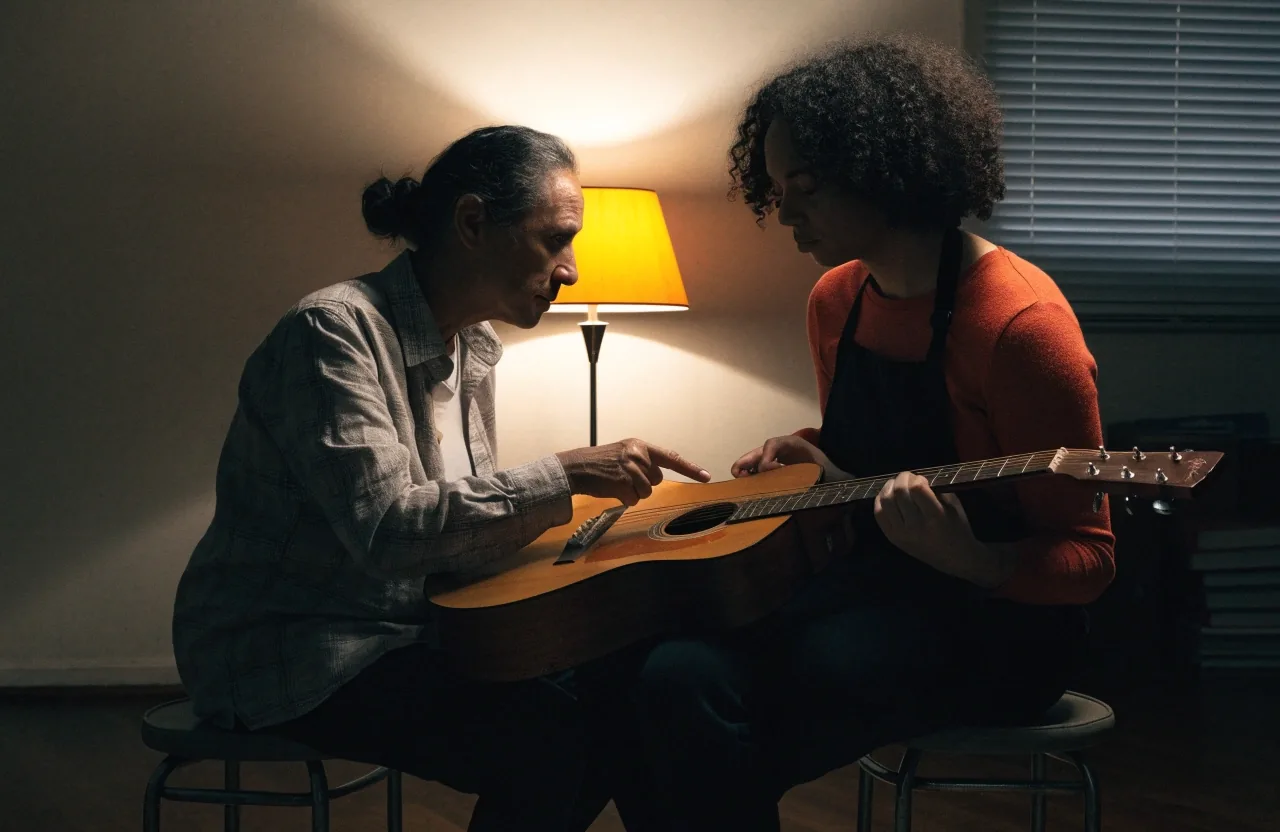
First session, one to one
The plan
A term-length plan, and how it changes
After the first session, a term-length plan is written with specific targets, from a clean chord change at tempo to a full piece played start to finish. It is reviewed regularly against those targets and rewritten when your goals shift, which they usually do once you can play something you like.
If you miss a fortnight because work got busy, the plan bends rather than restarts. That is one of the practical advantages of a studio over a marketplace of tutors, where each new teacher begins from zero and asks the same questions again. You should always know what you are working toward and why.
Targets are written down and reviewed, not remembered. Bring the plan to every lesson and we will mark progress against it.
Practice, in weeks
Fifteen focused minutes most days beats one long night before the lesson
Week one
Open chords, changing on the beat.
Week two
Keeping time with a slow backing track.
Week three
First strumming pattern held steady.
Week four
Half a song, start to the chorus.
Week five
Barre shapes, short bursts only.
Week six
The piece, played through once.
How much you practice is the single biggest factor in how fast you progress, and it is entirely in your hands. The plan will tell you what to work on and roughly how long it should take, so you are not guessing at a practice session or repeating the same eight bars for an hour without noticing. Short sessions on most days build finger strength and timing in a way one long session cannot, because the hands learn from frequency more than from duration.
If your week collapses, say so. Adjusting the workload is normal and far better than quietly falling behind for a month and then stopping.
The rail above is one example term: six weeks of a beginner plan, each week a single clear target. Yours will be written for your goals, not copied from this one.
If it is not the right fit, tell us early
Not every match works, and it is better to find that out in week two than in month six.
If the format, the teacher, or the material is not clicking, say so rather than drifting away from the lessons. We may suggest a different teacher, a different format, or, honestly, a different studio that suits what you are after. There is no penalty for stopping, and nothing is owed for a conversation about it. The point of the whole process is to get you playing, not to lock you into a schedule you dread turning up to.
If you are unsure before you start, it is worth asking a question first rather than booking anything. A short exchange by email or phone usually settles whether the studio is the right place for what you want to play.
Practical questions
Things people ask before they send the form
Short answers here; the full FAQ page goes further into levels, styles, and gear.
Read the full FAQHow long do replies take?
Enquiries are answered during the working week, Monday to Friday 9:00 AM to 6:00 PM. Saturday enquiries are usually picked up on the next working day. If you have not heard back within a few working days, call the studio on +44 20 7237 8067 and we will pick it up from there.
Do I need to know anything about music theory?
No. Theory gets introduced when it explains something you are already playing, which is when it tends to stick. Complete beginners are welcome, and saying clearly that you are one makes the first reply more useful, not less.
Can I change lesson format later?
Yes. Moving between in-person lessons in London or Westminster and live online lessons is straightforward, and learners do it for all sorts of reasons, from a change of address to a difficult winter commute. Just say what you want to change and we will look at the diary.
What if I miss a lesson?
Tell us as early as you can and the term plan adjusts around it. Missing a week is not a setback unless it turns into missing a month without saying anything, which is why we would rather hear from you than not.
Next step
Send the form, and we will take it from there
The enquiry form lives on the contact page. Fill in your level, the styles you are interested in, and roughly when you can play, and the studio will get in touch directly to arrange the next step. If you would rather ask something first, that works too, and there is no obligation on either path.
Studio details
-
Address
27 Denmark Street, London WC2H 8NJ, United Kingdom
-
Phone
-
Email
-
Working hours
Monday to Friday, 9:00 AM – 6:00 PM. Saturday, 10:00 AM – 4:00 PM.
Tuition is available in person at the London and Westminster studio, or live online anywhere in the UK.