
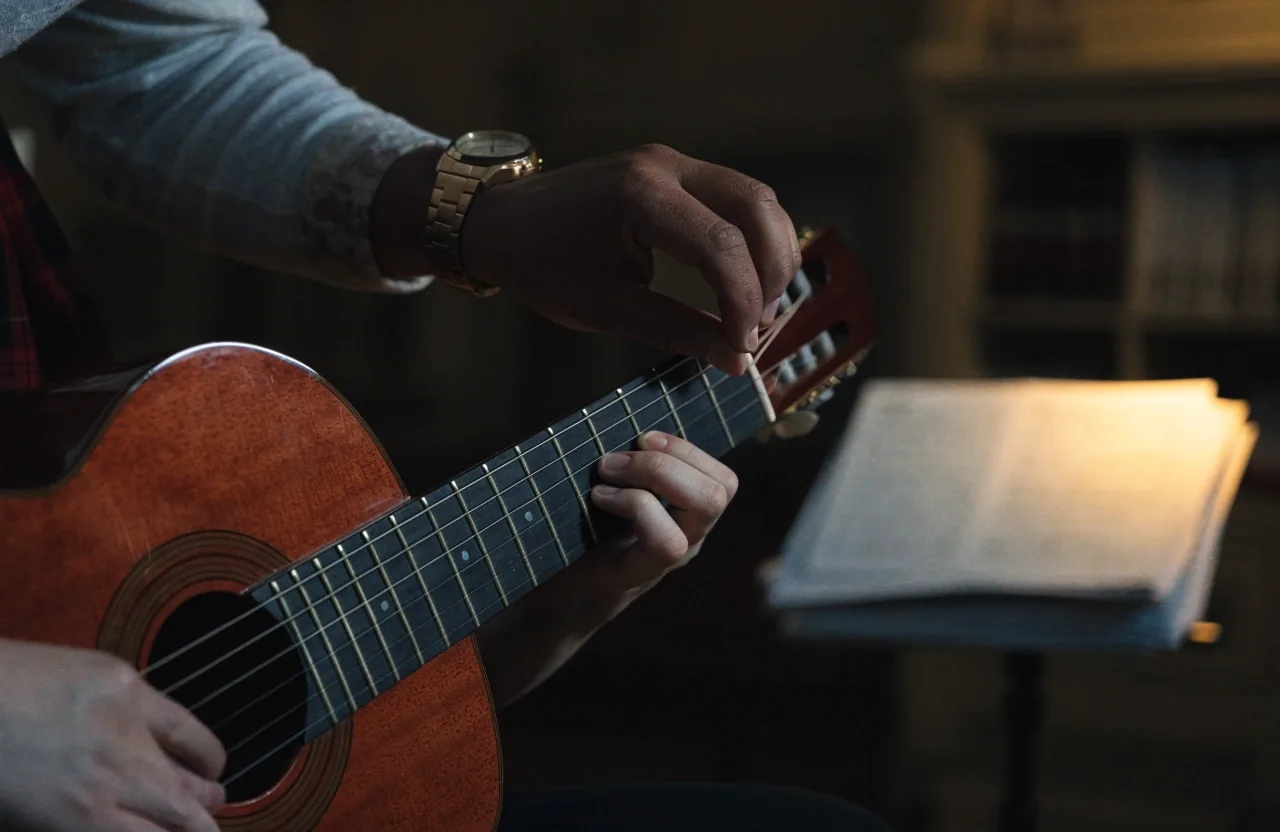
Guitar tuition · private lessons
About a Studio Built Around One-to-One Teaching
Private guitar lessons across acoustic, electric, classical and bass — in a central London teaching room, or live online wherever you are.
Who teaches here, how the lessons are built for different levels, and what the studio asks of you in return.
Fretwork Guitar Tuition is a UK studio that teaches private, one-to-one guitar lessons, in person in central London and live online for learners anywhere in the country. It exists because group classes and marketplace roulette suit some people badly.
This page explains who teaches here, how lessons are structured for different levels, and what the studio expects from you in return. Lesson fees are not listed on the site — they depend on format, level and frequency, and they get discussed directly once we understand what you need.
Who teaches at the studio
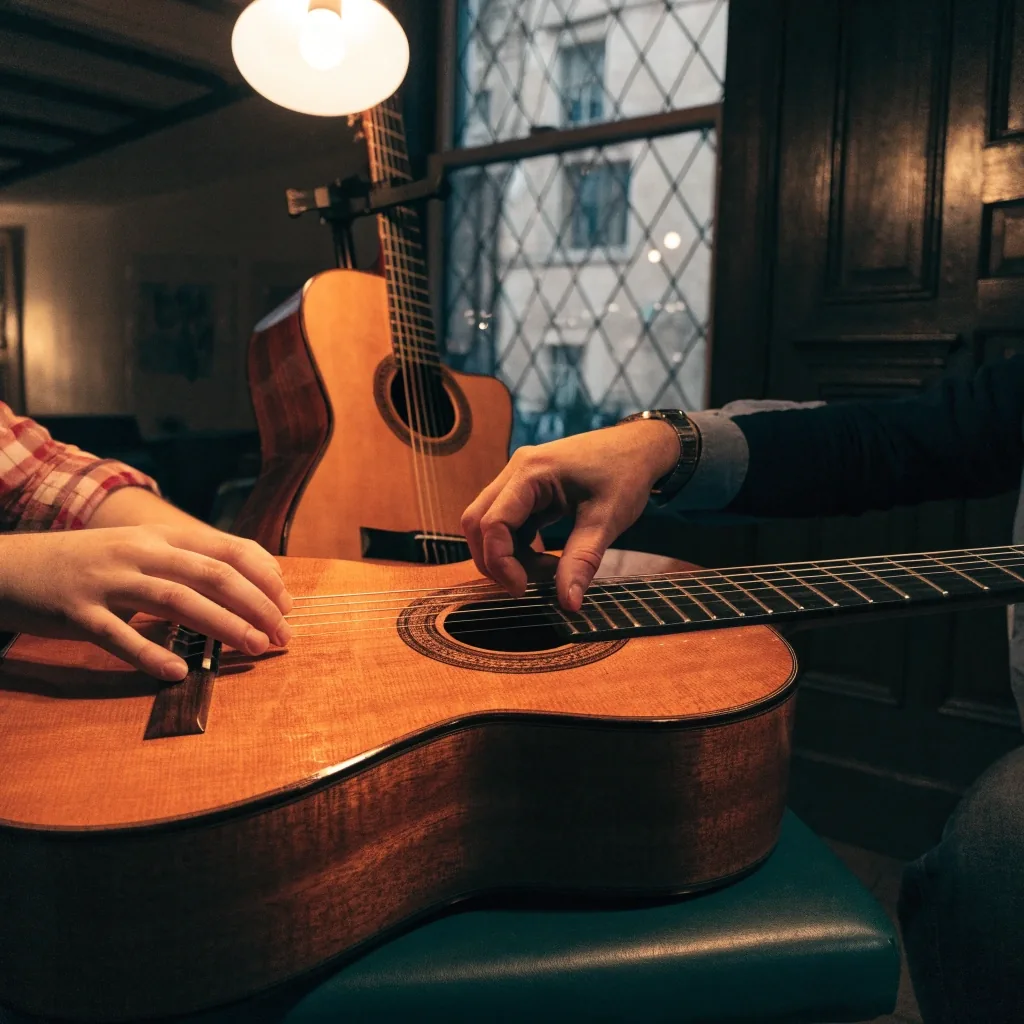
Lessons are taught by working guitarists who teach because they want to, not as a fallback between tours. The roster is kept small on purpose: fewer students per teacher means your history is remembered from one month to the next. Between us, the teaching covers acoustic, electric, classical, and bass, plus the styles those instruments actually get used for.
You will work with one teacher and stay with them unless there is a real reason to change. When a change is genuinely the right call — a switch in instrument focus, a shift in schedule, a specific style that sits better with another tutor — it is arranged openly rather than left to drift.
The teaching philosophy, stated plainly
How a lesson is ordered matters as much as what gets covered in it. Here is the reasoning behind the sequence.
Theory arrives when it is useful
Theory is a tool, not the subject. If a concept does not help you play something you care about, it waits. That does not mean shortcuts or skipping fundamentals, because bad habits are expensive to undo later — it means the order is chosen so that reading, ear training, and technique arrive when they are genuinely useful.
Two pathways, one honest choice
Students who want formal grades can have that path, with the repertoire, sight-reading and technical work that graded exams reward. Students who want to play songs with friends can have that one instead, focused on chords, feel and playing with others. Both are treated as legitimate goals, and neither one quietly becomes the default.
Feedback you can act on
Every session ends with a short spoken recap of what changed and what to work on next. If a passage still sounds uneven, you will know which hand is causing it, and roughly how long the fix usually takes — a fortnight of short sessions, not an open-ended grind. Vague praise does not help anybody, so the feedback stays specific.
How lessons are structured by level
The same one-to-one format runs in a central London room and through a video call, and level decides what the hour actually contains.
Face-to-face in the room
- Hands-on correction of posture, pick angle and fretting pressure in real time.
- Amplifiers, pedals and acoustics available, so tone questions get answered on the spot.
- Slots around the working week, including early evenings and Saturdays.
The same hour on a video call
- An identical one-to-one format, not a trimmed version of the lesson.
- Deliberate, camera-angled demonstrations, since a teacher cannot move your wrist through a screen.
- Reaches learners in Manchester, Edinburgh, Brighton and smaller towns that platforms cover thinly.
Online students often carry on that way after moving cities, because the continuity is worth more than the postcode. If you are unsure which room suits you, say so in the enquiry and we will talk it through.
How lessons are structured by level
Three honest starting points, and what the first several months tend to contain for each.
A beginner-friendly start looks at posture, a small set of open chords, strumming, and staying in time. Sessions stay short and structured, with one clear weekly win so the first month does not blur. Children usually take shorter, more tightly structured sessions with a parent in the loop about what to practise.
An intermediate player usually arrives with gaps: barre chords that buzz, no fretboard knowledge, or no idea how to improvise. Those get diagnosed in the first session and written into the plan, then worked one at a time so the fix sticks. Fretboard knowledge, movable chord shapes and simple soloing get woven in as they become relevant to the songs you are actually learning.
Advanced students tend to come with a specific target, such as a recital piece, a recording, or a technique that has plateaued, and the lesson becomes close work on that single problem. Expect slow, detailed repetitions, partly with a metronome and partly unmeasured, and expect the teacher to say plainly when a passage is not improving.
Writing a lesson plan that survives real life
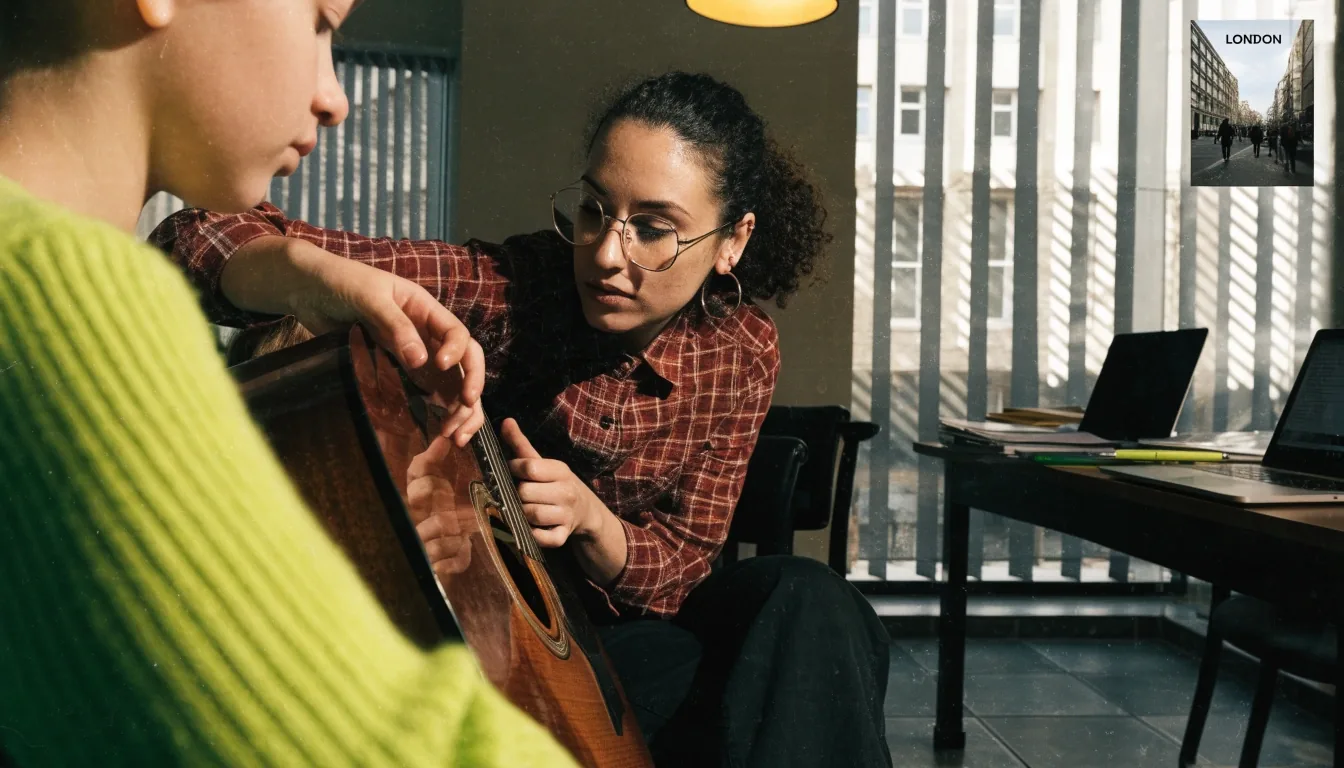
The plan is written for a term, not a decade, and it is reviewed regularly. It includes what you will practise between sessions and roughly how long that should take. If your week collapses, the plan bends rather than breaks, because a missed fortnight should not mean starting over.
Adult learners with demanding jobs make up a good share of the studio, and the scheduling assumes that — short, frequent practice beats long sessions squeezed in once a fortnight. Kids get shorter, more structured sessions with clearer weekly wins, and a note home about what was covered.
Every beginner starts with the same short task: one open-chord change, on a steady count, four beats each. Here is what the card for a first week actually looks like.
Wrist relaxed, thumb behind the neck, fingertips on the pads, not the flats.
G to C and back, four beats each, metronome at 60, five minutes a day.
Ten clean changes without stopping. If it still buzzes, we slow the tempo, not the goal.
A short exercise done five times a week beats an hour crammed in on Sunday. The whole point of the card is that you can see the week in one glance.
Face-to-face roots in London and Westminster
The studio's in-person teaching is based around central London and Westminster, which is the densest tutor market in the UK and also the least forgiving on travel time. Lessons are arranged around the slots that genuinely work, including early evenings and Saturdays. If you are coming from a specific district, say which, because twenty minutes of travel difference changes which slot is realistic. Some students book a fixed weekly time for a whole term just to protect it.
Not comfortable with any of those yet? Nobody arrives knowing which one they want. Say what you listen to and the first session will point at the right instrument and the right starting order.
What the studio is not
It is not a franchise, not a marketplace, and not a school with a set curriculum that everyone follows in step. It does not aim to be the largest studio in London, and it does not chase volume by filling classes.
Lesson fees are not listed on the site; they depend on format, level, and frequency, and they are discussed directly once we understand what you need. If you want to compare dozens of tutors in one place, a platform is the better first stop.
Expectations on both sides
This is a two-way arrangement, and the students who progress fastest are usually the ones who say what they actually want.
What we ask of you
- Come to lessons roughly on time and with the practice done, even partially.
- Tell us when something is not working — a technique that hurts or a piece that bores you is worth saying out loud in week two rather than month six.
- Bring the songs you actually want to play, however far away they feel. They usually turn into the plan.
What you get in return
- A teacher who remembers your goals from one month to the next and adjusts the plan around them.
- A term-length plan you can see, with rough practice times so you know what the week actually costs.
- Straight answers about progress, fees and format. If a question is better suited to a phone call, that is arranged too.
From enquiry to first lesson
Three steps, and no obligation to book anything until you have spoken to a teacher.
You send the enquiry
Tell us your level, which instrument, whether you want in-person or online, and anything you already know you want to play. Two sentences is enough to start.
We get in touch directly
A teacher replies personally to arrange a short conversation, check which slot works, and talk through fees for your format and frequency. There is no automated handoff.
First lesson and a plan
The first session diagnoses where you are, and by the end of it a term-length plan exists. It gets reviewed regularly, and it is yours to keep working from.
Studio details
- 27 Denmark Street, London WC2H 8NJ, United Kingdom
- +44 20 7237 8067
- [email protected]
Opening hours
- Monday to Friday, 9:00 AM – 6:00 PM
- Saturday, 10:00 AM – 4:00 PM
- Enquiries sent outside those hours get answered on the next working day, not by a machine.
If any of this sounds like the way you want to learn, the next step is a short conversation about what you want from the guitar.
Prefer to read before you write? The lessons page covers formats and styles in detail, and the FAQ answers the practical questions about scheduling and levels.