
Straight Answers About Guitar Tuition
The questions that come up most often in enquiries, answered without padding. If yours is not here, the studio takes lesson requests by form and replies directly.
Nothing here is graded. Each week adds one thing you can already do, and the card fills in behind you.
Choosing an instrument and a style
Acoustic is the most commonly listed lesson type on UK tutor platforms and the usual starting point, because a guitar and your hands are the whole setup. Electric is often easier on beginner fingers and suits rock, blues and pop, though it wants a small amp alongside it. Classical uses nylon strings and formal right-hand technique, and it rewards players who want to read music rather than play from memory.
Pick the one matching the songs you want to play now, not the one you think you should choose. Guitars are forgiving about being lent, borrowed or swapped, and a change of direction halfway through a term costs you nothing but a restring.
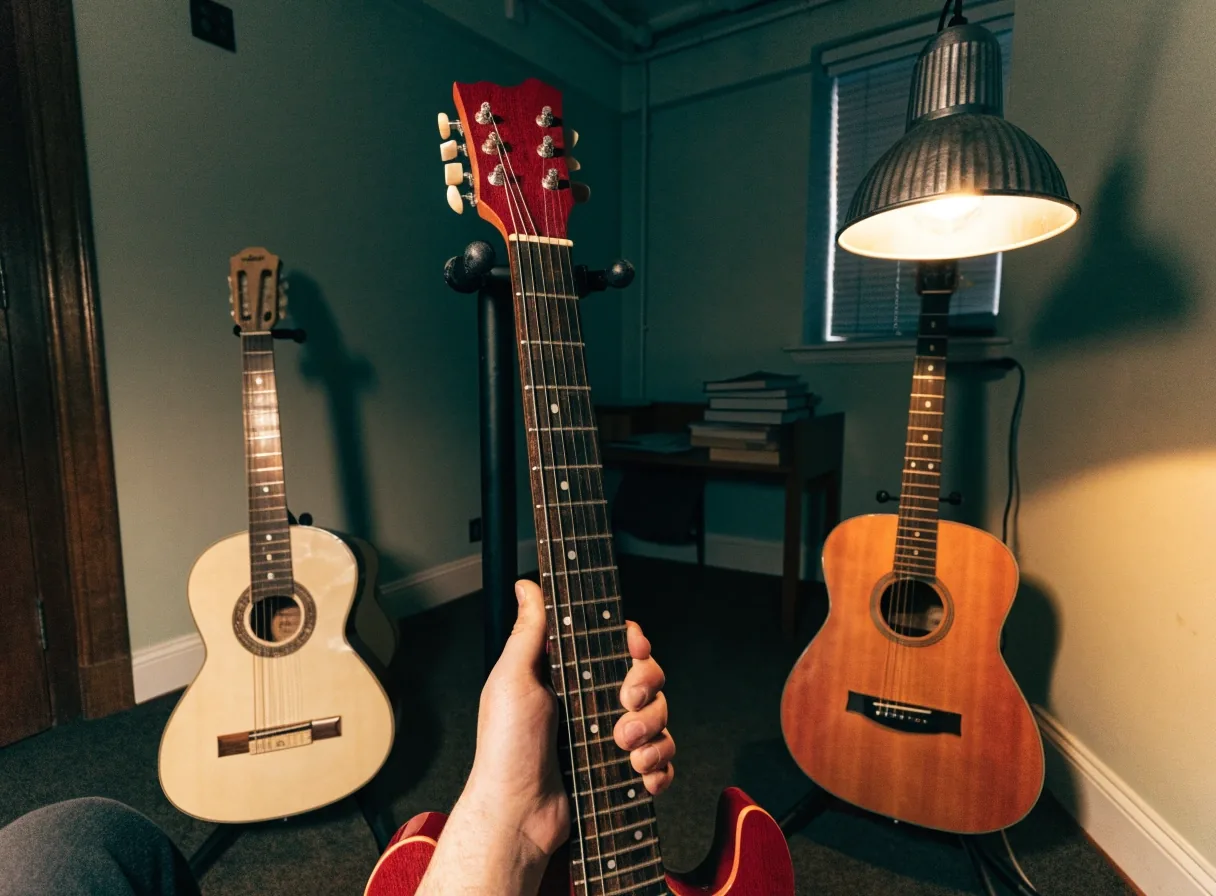
A first instrument is a starting point, not a final decision.
The honest test is simple: can you name three songs you want to play on it by the end of the month?
In person or live online
The teacher can move your hands
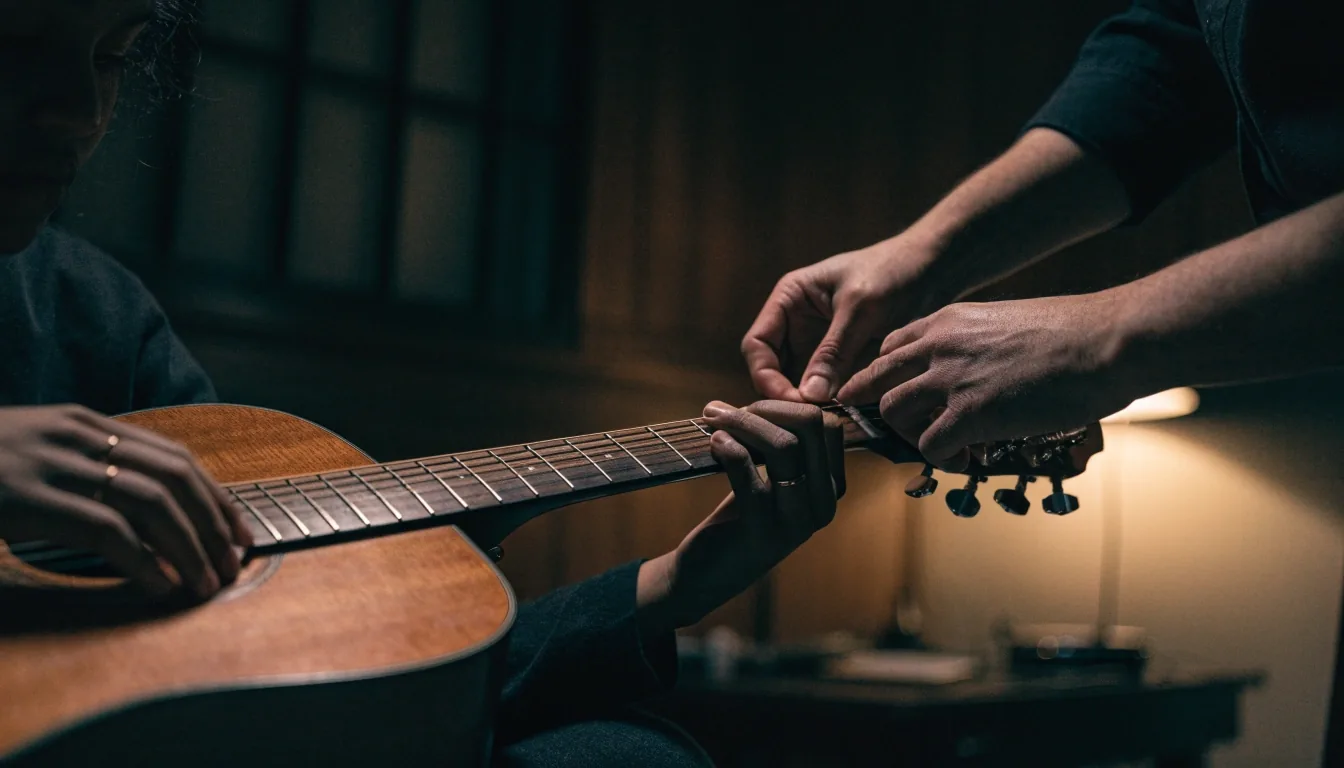
Face-to-face lessons in London and Westminster let the teacher physically correct your hands, which is fastest in the first months. Wrist angle, thumb position, how hard you press behind the fret — small physical things that are hard to describe and easy to show. If you can reach the studio weekly, this is where progress tends to move quickest.
It also gives you a real reason to leave the house with a guitar, which turns out to matter more than most people expect when practice time is scarce.
The same material, no travel
Live online lessons run the same material through a video call and suit anyone whose travel time is the real obstacle. You still get real-time correction: play something, hear the note back. Neither format requires specialist software — a laptop, tablet or phone camera is enough, and a headset helps more than a better microphone.
Many students mix both, using in-person sessions for technique and online sessions to keep momentum through a busy week. The choice is mostly about your week, not your level.
If the question is which one is better, the answer is which one you will actually turn up to on a wet Tuesday.
What a first lesson is like
The first session is diagnostic, not a performance. We hear you play, find out what you want to work on, and identify the gaps.
A beginner usually leaves with posture notes, a couple of chords they can already shape, and one specific thing to practise before the next session.
Someone coming back leaves with a clearer picture of what has stuck, what has not, and which habits are quietly holding the playing back.
Nobody is asked to sight-read, recite theory or prove anything. Whatever you can already do is the starting line, and it is a working session from the first minute.
There is no exam at the end and no report card. You get a lesson plan you can read, and the sense of where the next few weeks are heading.
Most people arrive apologising for how they play. Nobody has ever needed to.
Do you teach children and adults?
Yes, and they are taught differently. Age matters less than available practice time, which is the honest answer to most questions about pace. What changes with age is how the session is built, how long it runs, and what counts as progress in a given week.
Adults
Adults tend to want the reasoning behind a technique and can handle longer sessions. We explain why a fingering works before drilling it, and you are welcome to argue with the explanation.
Children
Children do better with shorter, more structured lessons and clear weekly goals. A short session that ends while it is still fun beats a long one that ends in frustration.
Teenagers
Teenagers usually progress fastest when the material connects to what they actually listen to. Bring a song; we will find the technique hiding inside it.
The real variable is not age. It is how many evenings a week a guitar actually gets picked up.
Equipment and practice
Nothing expensive is required at the start, and you do not need to buy anything before a first lesson. This is the whole list, with what each item actually does for you.
Fifteen focused minutes most days beats one long session before a lesson. Consistency matters more than duration, and short daily practice is easier to keep going when a week gets busy. The lesson plan states what to work on and roughly how long each piece should take, so you are never standing in a room guessing what to do next.
Bring the vague things to the lesson: the chord change that never lands cleanly, the barre that buzzes, the strum that sounds flat next to the recording. Those are the useful questions, and they are easier to solve in the room than alone.
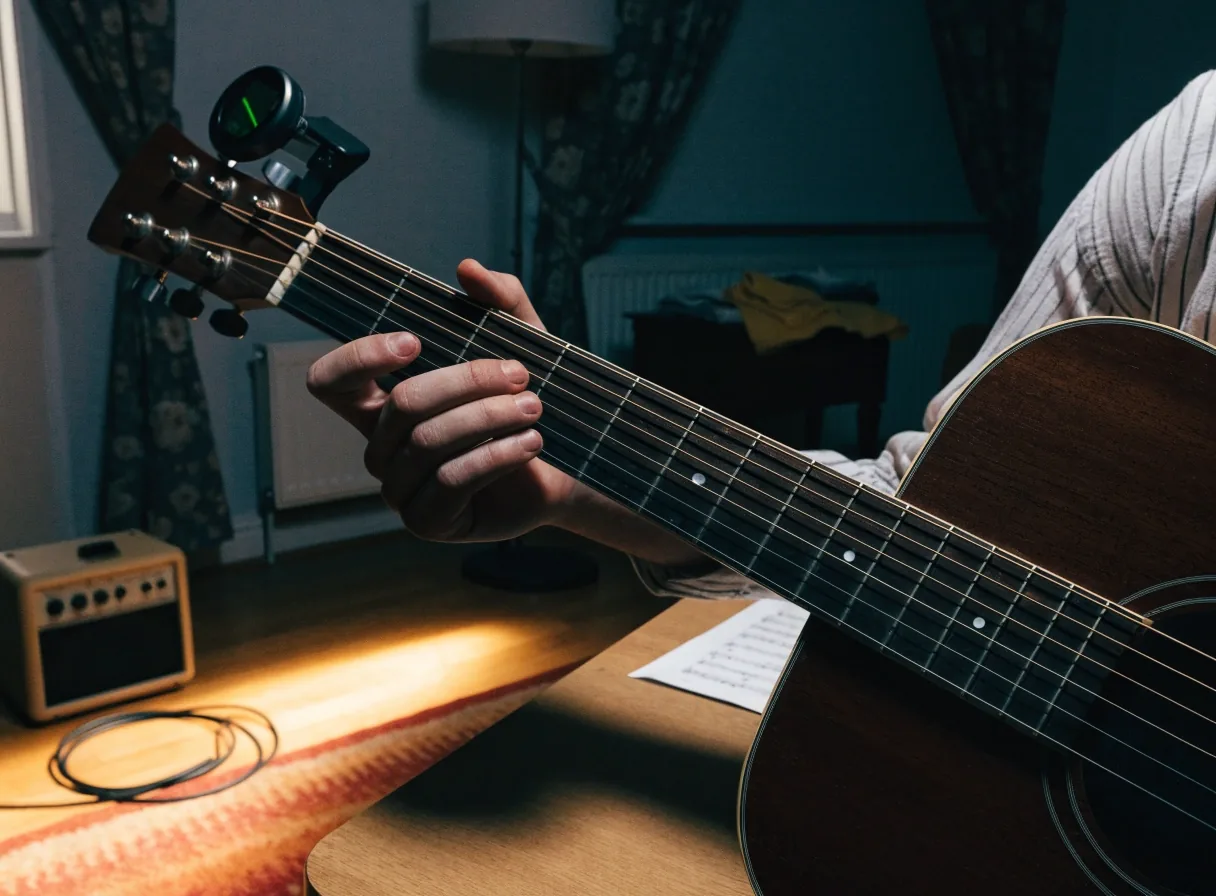
The practice corner does not need to be tidy, only reachable.
Scheduling and cancellation
Evenings and weekends are the most requested slots and fill first, so flexibility on the day helps a lot. If your week is unpredictable, fortnightly lessons work better than a weekly slot you keep cancelling — a plan you can hold beats a plan that looks busier on paper.
Tell us honestly how often you can commit and the plan gets built around that. Life happens; the plan bends rather than breaks. When you know a session is going to be missed, say so early and it is usually possible to move it rather than lose it.
- Monday to Friday
- 9:00 AM – 6:00 PM
- Saturday
- 10:00 AM – 4:00 PM
- Sunday
- Closed
Enquiries sent outside these hours are read the next working day.
Finding a teacher in London or elsewhere
London has the densest tutor market in the UK, with listings across Westminster and the wider boroughs, and strong regional demand in Manchester, Edinburgh and Brighton. Marketplaces are useful for comparing many tutors quickly. A studio is better for continuity: one teacher who knows your history and a plan that builds week on week. If you want to sample several approaches before settling, start with a platform and come back when you know what you are looking for.
Fees and booking
Lesson fees are not listed on this site. They depend on the format, the length of the session and how often you want to play, so a published number would be misleading for most people. Fees are discussed directly once we understand what you need and how the week is shaped.
Nothing is charged for the initial enquiry or the conversation that follows it. Send the form, the studio reads it, and one of us gets back to you to talk through format, timing and level before anything is arranged.
The enquiry form on the contact page collects your name, email, the instrument you play and what you would like to work on. That is enough for the studio to reply with something useful rather than a generic reply.
- Address
- 27 Denmark Street, London WC2H 8NJ, United Kingdom
- Phone
- +44 20 7237 8067
- [email protected]
Enquiries are read and answered directly by the studio. Nothing is charged for asking.
Six fields, one form, and the studio answering you directly. That is the whole arrangement.
If your question is not here
The contact page has the form and the studio replies directly. If you would rather read more first, the pages below go deeper on the two things people ask about most: what a term of lessons actually covers, and how the online format runs.